
CNN Revives K‑Pop Idol’s Racial Controversy
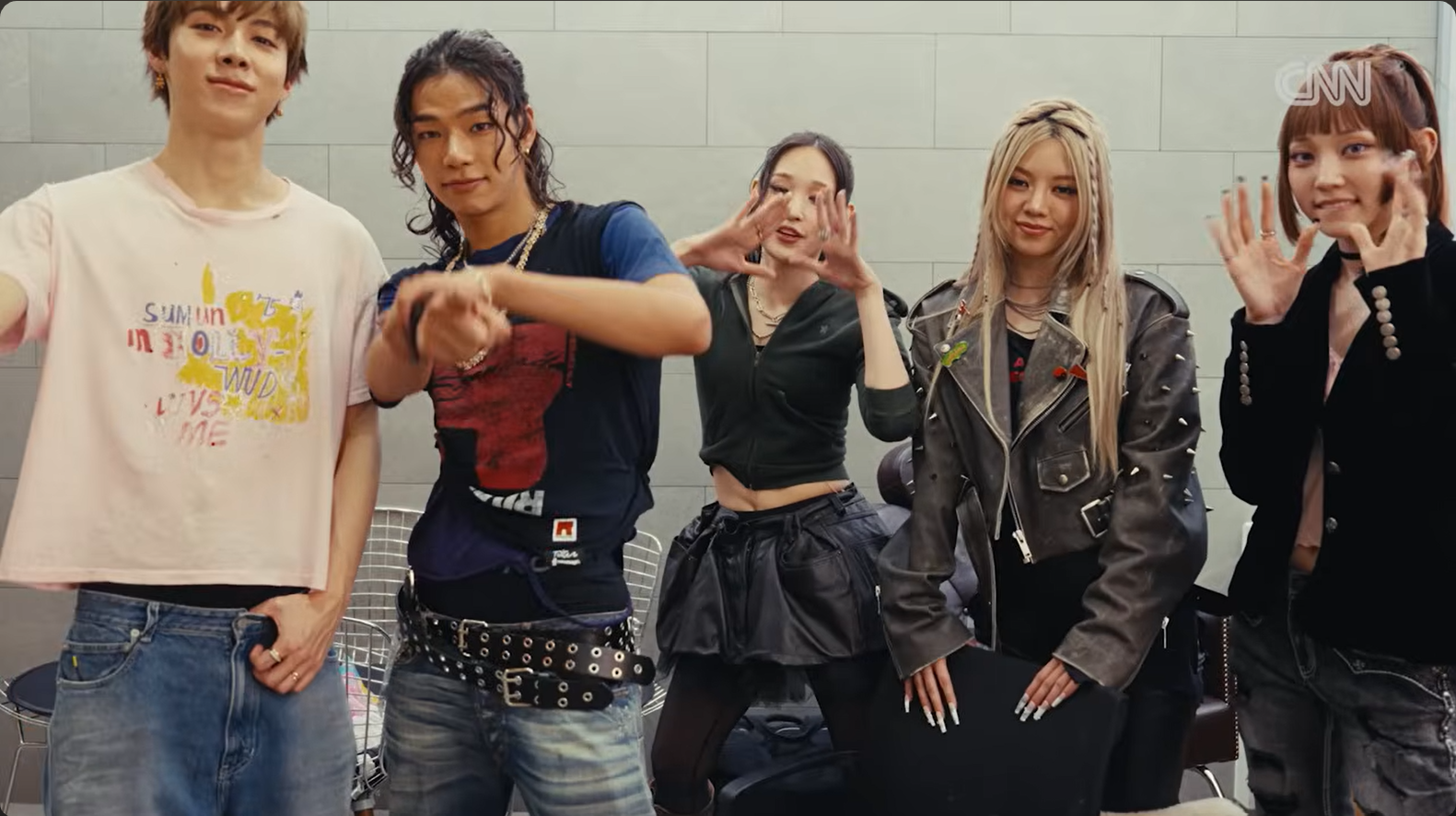
ALLDAY PROJECT poses for a promotional photo. Tarzzan, second from the left and shown sagging his pants, is facing renewed scrutiny as CNN’s K‑Everything introduces the group to American audiences amid resurfaced allegations involving a viral racial‑slur video.
By Rob Redding
Editor & Publisher
NEW YORK, April 7, 2026, 3 p.m.(Updated 4/8/26, 10 p.m.) — As CNN prepares to introduce American audiences to Korean pop culture through a new four‑episode series, unresolved questions about a rising K‑pop idol’s racial controversies are resurfacing. The timing has renewed scrutiny of how the global industry engages with Black culture and how little of that history is reflected in mainstream coverage.
Lee Chae‑won, 23, who performs as Tarzzan in the coed group ALLDAY PROJECT, appeared in a viral video last year rapping along to Playboi Carti’s “LIKE WEEZY.” Viewers said he replaced the word “boy” with the N-word. The clip was first uploaded to TikTok before being reposted across platforms and later removed from YouTube. Although the incident prompted widespread criticism at the time, neither Tarzzan nor his agency, THEBLACKLABEL, issued a public response.
The controversy has regained attention as CNN prepares to premiere K‑Everything, a cultural exploration of Korea’s global influence hosted by Daniel Dae Kim. The series debuts May 9 on CNN International and will stream on the CNN app in the United States. Tarzzan appears briefly in the series trailer, which has circulated widely since its release on March 26. For many American viewers, the program will serve as a first point of contact with the K‑pop industry.
Critics say the resurfaced video is part of a longer pattern that has gone largely unexamined outside fan communities. According to reporting from The Express Tribune last July, observers pointed to Tarzzan’s use of braids, grills and other styling drawn from Black culture since his debut. One user wrote that “everything about that Tarzzan guy should have gotten him cancelled even before his debut,” while another noted that he had “not issued a single apology or acknowledgement of his actions,” the paper reported.
The renewed backlash has intensified as observers accuse the singer of responding to criticism by adopting more visual cues associated with American hip hop rather than addressing the concerns directly. Detractors argue that the shift reflects a superficial engagement with Black culture. THEBLACKLABEL has not commented.
On Reddit, where discussion of the incident has been active, one user compared the situation to the experiences of Korean expatriates raised in African countries. The commenter described a YouTube interview with two Korean men who grew up in West Africa and spoke with the cadence and cultural grounding of the communities that raised them. “These guys look Korean, no braids or cornrows in sight. But the way these guys speak, they are African,” the user wrote. “When they go to Korea, they look Korean and are seen as Korean until they open their mouths, and immediately it is clear they are foreigners. The culture they grew up in and immersed themselves in since childhood is not something they can easily scrub off.”
The commenter contrasted that experience with what they described as the idol’s selective performance of Blackness. “Chaewon is not a fan of hip hop or rap. ‘Tarzzan’ is a costume he puts on to make money,” the user wrote. “Tarzzan is not appreciation. He is a minstrel show.”
The controversy intersects with a growing body of scholarship examining how K‑pop engages with Black culture. Courtney Anderson, whose 2021 work on “vigil labor” examines the emotional and digital labor Black fans perform in monitoring racial offenses, argues that fandom spaces often require marginalized fans to police the industry’s use of Black culture. Crystal S. Anderson, author of Black K‑Pop: Racial Surplus and Global Consumption, has described K‑pop’s use of Black aesthetics as a “racial surplus,” a commercial tool detached from its cultural origins. Scholars including Rukmini Pande, Grace Ting and Rebecca Wanzo have documented the emotional toll on marginalized fans who must navigate fandom spaces that promote inclusivity while simultaneously reproducing racial exclusion.
The resurfacing of the video has raised questions about how major media outlets present Korean pop culture to global audiences. While K‑Everything highlights Korea’s creative achievements, critics say the industry’s racial dynamics remain underexamined, and that the absence of accountability in cases like Tarzzan’s reflects a broader pattern.
CNN did not respond to a request for comment. However, following the inquiry, the network updated the promo and removed the image of Tarzzan sagging his pants.